
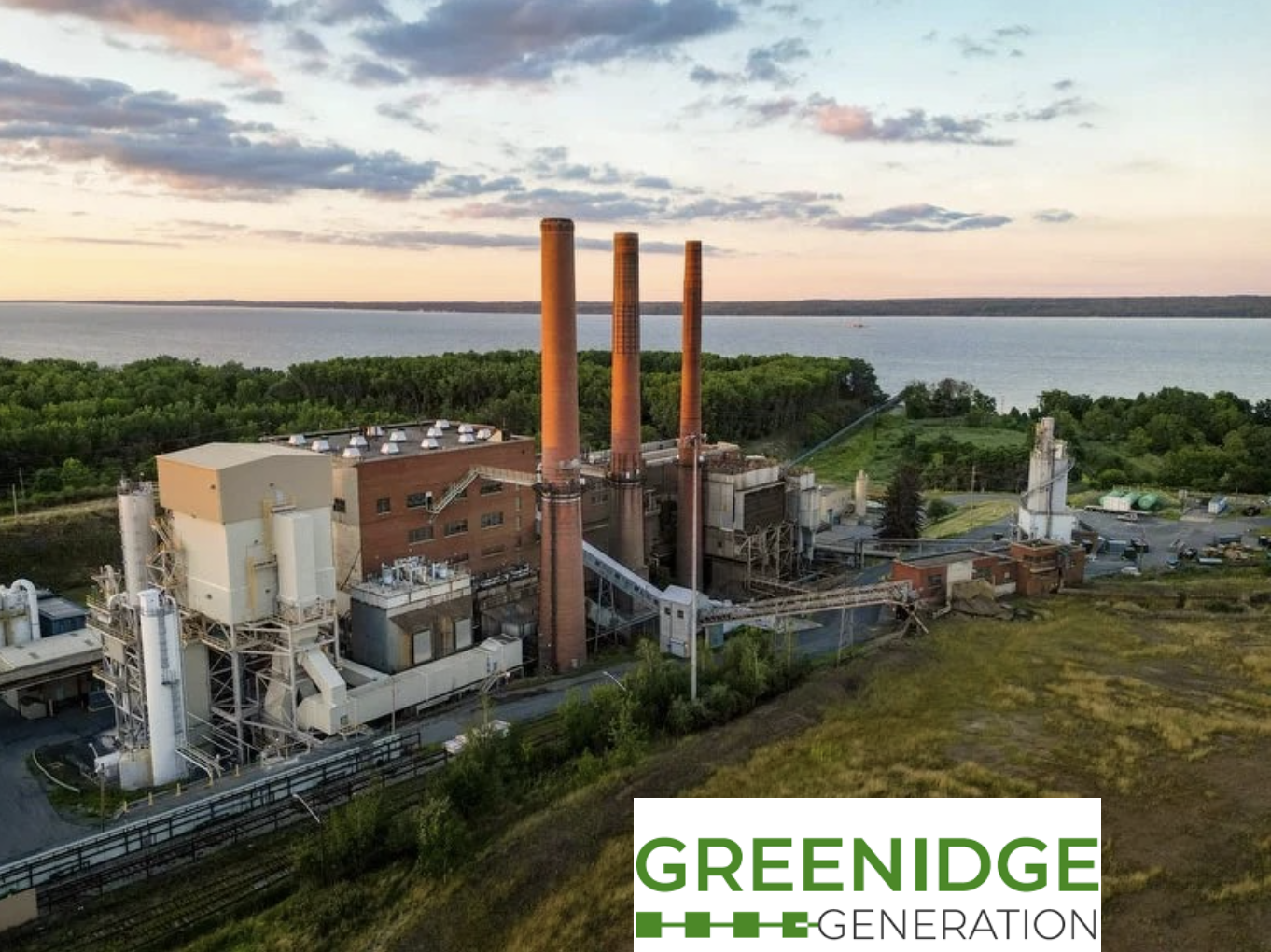
DRESDEN, Oct. 28, 2024 — Greenidge Generation LLC plans to make its closing arguments in Yates County Supreme Court tomorrow for a preliminary injunction to block a state order to shut down the company’s power plant on Nov. 1.
Attorneys for the state Department of Environmental Conservation will ask Judge Vincent Dinolfo to reject the injunction request. The hearing is set for 10 a.m. at the county courthouse in Penn Yan.
The shutdown order stems from the DEC’s June 2022 decision to deny the company’s bid to renew its Title V air permit because the Dresden plant’s emission levels conflict with the state’s climate law.
The 107-megawatt plant and its Bitcoin mining facility on the western shore of Seneca Lake have continued operating ever since, pending Greenidge appeals, first within the DEC and then in state court.
“If (the agency’s permit) denial is permitted to remain in place and a preliminary injunction not issued, Greenidge will be required to shut down the facility and move its cryptocurrency operations out-of-state,” Greenidge president Dale Irwin said in an affidavit filed Oct. 24. All but two of the plant’s 31 employees would lose their jobs and Yates County would lose important tax revenue, Irwin added.
The case tests the reach of the DEC’s authority under the 2019 climate law to deny air permits to plants based on the emissions they create.
The DEC notes that the Climate Leadership and Community Protection Act (CLCPA) says state agencies “shall consider whether (permitting) decisions are inconsistent with or will interfere with the attainment of (statewide greenhouse gas) emissions limits.”
The law requires the state to reduce its greenhouse gas emissions by 40 percent by 2030 and by 85 per by 2050 (based on 1990 levels).

Attorneys for Greenidge argue that the DEC has improperly “weaponized” the permitting provision and that it lacks the authority it claims. Greenidge’s final brief in favor the injunction is here. The DEC’s latest response brief is here.
Several outside interest groups are weighing in on the company’s lawsuit, which names the DEC and its acting commissioner, Sean Mahar, as defendants.
Judge Dinolfo has granted three environmental groups party status, and he has allowed several others to file amicus curiae briefs — some in favor, some against the requested injunction.
“Our climate laws are only as strong as their enforcement,” said Roger Downs, conservation director of the Sierra Club’s Atlantic Chapter. “It has been more than two years since New York correctly rejected Greenidge’s cryptomine air permit but the plant still continues to operate, profit and pollute while it exploits the state’s appeals process.”
Meanwhile, two influential Albany-based business groups that side with Greenidge are expected to file amicus briefs today, arguing for the injunction that would keep the plant open.
The Independent Power Producers of New York claims that the Greenidge plant is crucial to the state’s electric grid, while the Business Council of New York argues that overly strict enforcement of the CLCPA would impose “costly and damaging compliance mandates” on the state’s business community.

The “draconian and severe consequence” of the DEC’s permit denial would set a dangerous precedent by ignoring potential justification for high emissions, the Business Council’s Kenneth Pokalsky said in a recent affidavit.
“The department could determine they are under no obligation to consider any justification, no matter how vital to maintaining New York’s grid or economy,” said Pokalsky, the group’s vice president and lobbyist. The state legislature has not delegated any such authority to the agency, he argues.
The Dresden plant devotes most of the electricity it generates to powering its Bitcoin mining operation, but it also sells power to the grid. Greenidge says that the New York Independent System Operator has at times asked it to suspend Bitcoin operations and shift power to the state grid when electricity supply is tight.

“The grid needs generation that can turn on, ramp up … to meet consumer demands regardless of the weather,” Gavin Donohue, president of IPPNY said in an Oct. 10 affidavit. While older, less efficient fossil fuel plants like Greenidge are NYISO’s last resort when power demand soars, “without these fossil fuel units, the state would suffer significant blackouts.”
But the DEC counters: “While Greenidge alleges that NYISO called upon it to deliver power to the grid, it neither explains the context nor submits supporting documents. Without more, these assertions may represent little more than Greenidge determined it profitable to sell power to the grid.”
The Greenidge plant is quite inefficient, according to an amicus brief filed by Fossil Free Tompkins, an Ithaca-based environmental group. It burns natural gas to power a 1953 simple-cycle generating unit that boils water to produce steam that turns a turbine — a technology that became outdated when far more efficient combined-cycle units became the industry standard in the 1970s.
“Greenidge uses an antiquated, inefficient method of power generation, that, for any given unit of energy produced, uses more fuel and produces more greenhouse gas emissions than newer combined-cycle plants.”
Furthermore, FFT notes, the plant requires enormous amounts of water drawn from Seneca Lake to cool its machinery because of its outdated “once-through” cooling system. Most plants built after 1960 use “closed-cycle cooling,” which reduces fish kills and water use by 95 percent.
Also, the plant expels so much warmed water into Seneca Lake that it violates state rules on warm water pollution. It relies on a DEC waiver to avoid penalties.

Judge Dinolfo denied FFT’s bid for party status in the case, but he granted it to Seneca Lake Guardian, the Sierra Club and Committee to Preserve the Finger Lakes because, as the groups’ attorneys wrote in a filing Aug. 20:
“Proposed intervenors’ members and volunteers that live, work, and recreate near the plant and in the surrounding community are directly harmed by the increased air, noise, and water pollution that arises from Greenidge’s constant, around-the-clock operation.”
The three groups had asked the judge not to allow IPPNY or the Business Council to file amicus briefs.
The Dresden plant began operations in the 1930s as a coal-fired facility. In 2011 its owners mothballed the plant and gave up their Title V air permit.
Atlas Holdings, a Connecticut-based private equity group, bought the plant in 2014 and converted it to burn natural gas before restarting it in 2017.
The company had obtained a new Title V air permit in 2016 based on its plan to operate solely as a source of intermittent power to the grid. But because of slack demand, the plant often sat idle.
In 2019, Greenidge announced that it had launched a Bitcoin data center, using “behind-the-meter” electricity — power that never reaches the electric grid — produced by the plant. Since then the plant has produced six times as much energy and greenhouse gas emissions, the DEC says.
Bitcoin mining operations across the globe compete with each other to solve complex math problems with special-purpose computers. The winners earn one Bitcoin, which today sells for about $69,000.
Greenidge, which claims nascent Bitcoin operations in South Carolina and other states, recently reported that it sold 167 Bitcoin in its financial third quarter, which ended Sept. 30. The company estimated that it lost $6.6 million from continuing operations during the period.
The company has been struggling financially because of its heavy investments in Bitcoin mining equipment.
In 2021, the company attempted to raise cash in the stock market by going public through a reverse merger with Support.com. But that strategy has fizzled because the resulting stock has lost more than 99 percent of its value.

On Oct. 14, the NASDAQ stock market warned the company that it faces delisting unless it boosts its share price, according to the company’s recent filing with the U.S. Securities and Exchange Commission.
Failing to raise necessary funds in the stock market, the company began borrowing heavily to finance the newer machines required to effectively compete for Bitcoin prizes.
The resulting debt load has crippled financial performance and forced the company to disclose in several SEC filings that there is substantial doubt that it will be able to continue as a going concern.
Bitcoin was the first successful digital currency, and it still leads the cryptocurrency world in market capitalization. However, virtually all new competitors are using a more efficient method of confirming transactions, according to an amicus brief in the Greenidge lawsuit filed by Colin Read, a money and banking professor at SUNY-Plattsburgh.
Bitcoin mines rely on a “proof-of-work” system for confirming digital transactions, while every new digital currency uses a different, more efficient system know as “proof-of-stake,” says Read, a former mayor of the City of Plattsburgh.
“I remain very troubled not by digital currencies, but by one particular cryptocurrency that refuses to abandon the wasteful proof-of-work mining technology,” Read said. “There are better ways to both create and memorialize digital currencies that use 1 percent or less of the energy Bitcoin commands.”

 Water Front- Peter Mantius
This reads like a spoiled child ie you are punishing us because we are using our power for Crypto – not because we are polluting beyond the limits set by DEC and NYS. Really? And after watching this show for 5 years I can guarantee you the the DEC is anything but Capricious and and arbitrary!!!
Third, State Respondents and Intervenors assert that Greenidge would not be irreparably
harmed if the status quo is not preserved because “Greenidge could continue computing operations
without running the [electric generating facility] to power those operations. NYSCEF Doc. 97,
p.34; see also NYSCEF Doc. 109, p. 13 (“Greenidge’s cryptocurrency mining operations—its
primary revenue source—may continue without the Facility’s gas plant operation.”). This is
nonsensical and demonstrates, yet again, the arbitrary and capricious nature of the Department’s
decision-making. Indeed, the Denial is based, not just on an increase in greenhouse gas emissions,
but more specifically on an increase in greenhouse gases due to the facility’s change in “primary
purpose” to power, behind the meter, its cryptocurrency operations. NYSCEF Doc. 13, p. 8. As
detailed in the Denial:
LikeLike