

SENECA FALLS, Oct. 7, 2024 — One year after a unanimous town resolution called for a state analysis of lung cancer patterns around the Seneca Meadows Inc. landfill, the state’s health and environment agencies have failed to deliver.

In the absence of that requested examination of troubling evidence, SMI has submitted a draft environmental impact statement (DEIS) for its proposed “Valley Infill” expansion that dismisses the issue with a bald assertion:
“The Seneca Meadows Landfill has had no impact and the SMI Valley Infill will have no impact on lung cancer rates.”
SMI backs up that statement by claiming compliance with “health-based standards” detailed in another section of the DEIS that includes other unsupported assertions, such as:
“Only treated leachate is discharged to the local sewers which does not produce any objectionable odors.”
Strong evidence of sickening “sewer gas” — hydrogen sulfide — linked to the landfill is omitted.
The state Department of Environmental Conservation (DEC) is now poised to decide whether to approve the DEIS or order revisions. The agency and SMI have agreed on a Nov. 12 deadline for that review, which is a crucial step in a bid by the state’s largest landfill to cancel its scheduled closing in December 2025 and extend its operations for 15 years — until 2040.
The DEIS says the state Department of Health (DOH) is studying lung cancer rates in northern Seneca County for the years 1996-2020, but it provides no assurance that any results will be included in the final environmental impact statement.
The DOH said in a recent statement to WaterFront that it does not expect to deliver its lung cancer analysis to the DEC until “the end of 2024 or early 2025.”
Meanwhile, SMI and the DEC are defendants in an air emissions lawsuit, which notes that the DOH “has recently identified a lung cancer cluster in the vicinity of the landfill…”
Plaintiffs claim they’ve been “sickened and nauseated” by noxious landfill odors, and they allege “the potential connection between these air contaminants and the cancer cluster.”
The health department designated a 25-mile-wide circle that includes SMI as lung cancer “cluster LU-H-17” for the years 2011-2015 — the latest period for which DOH has publicly identified clusters.
But evidence that air emissions from Seneca Meadows have boosted local lung cancer rates is not conclusive. In fact, evidence that the landfill is even located within an area of high lung cancer rates is not reliable, the DOH now says.
The agency told WaterFront that the methodology used to identify “LU-H-17” in 2011-2015 has been revised. A subsequent DOH analysis with a “more appropriate” methodology found “no lung cancer clusters in Seneca Falls or Waterloo.”
The initial methodology had yielded at least 20 clusters of high lung cancer cases across upstate New York for the 2011-2015 period. Those areas stood out from the state average, which included areas around New York City, where lung cancer rates are dramatically lower than the rest of the state because smoking rates are far lower. The revised methodology used an average that excludes the Bronx, Brooklyn, Manhattan and Queens.
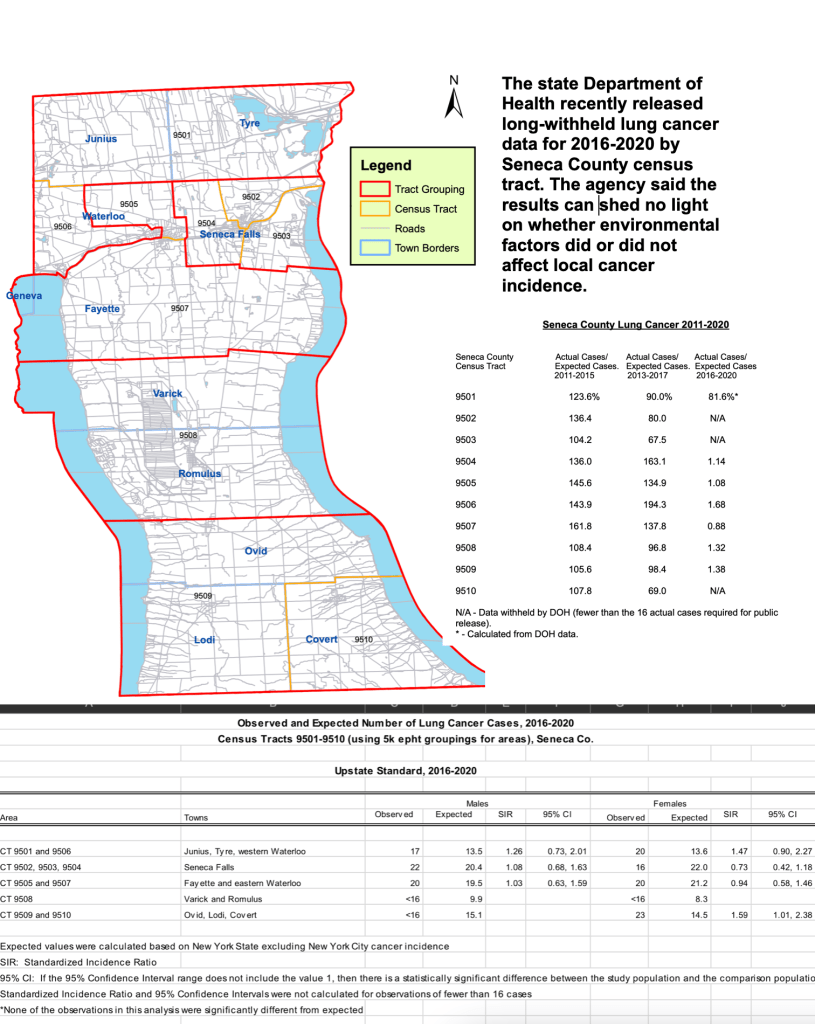
But an examination of lung cancer patterns by Seneca County census tract — a more precise measure than the much larger cluster areas identified by DOH — suggests the influence of emissions from Seneca Meadows.
For the periods 2011-2015 and 2013-2017, four census tracts near the landfill had unexpectedly elevated rates of lung cancer while more distant census tracts generally did not. “That’s definitely telling,” Dr. David Carpenter, director of the Institute for Health and the Environment at the University of Albany, told WaterFront in June 2023.
Last summer, WaterFront requested the DOH’s more recent census tract data on lung cancer in Seneca County: data for the 2016-2020 period. The agency declined to release it for 15 months before finally yielding it Friday.
The provided results showed that the ratio of actual cases of lung cancer to statistically expected cases declined during the 2016-2020 period for all four of the census tracts near the landfill. And ratios of actual-to-expected cases rose for two census tracts well to the south of the landfill.
And as a group, the three Seneca Falls census tracts east — and downwind — of the landfill had 10 percent fewer lung cancers than expected during 2016-2020.
The landfill, which straddles the towns of Waterloo and Seneca Falls, is mostly in census tract 9504. Actual lung cancer cases there exceeded expected cases by 36 percent in 2011-2015, by 63 percent in 2013-2017 and by 14 percent in 2016-2020.
Actual cases also outpaced expected cases for all three five-year periods for the two census tracts west of the landfill — 9505 and 9506. Waterloo High School and Waterloo Middle School sit near the border of those two census tracts.
Heather Bonetti, a teaching assistant at the middle school, is plaintiff in the lawsuit against SMI and the DEC. The suit alleges that Bonetti’s students are distracted and sickened by landfill odors.
On Sept. 3, Bonetti told the Seneca Falls Town Board that she had reported odors on the landfill’s odor hotline “only to receive the infamous letter from SMI: ‘No odor detected.’”
That evening the board postponed until December a vote on whether to grant SMI a local operating permit after a parade of more than a dozen people testified about offensive odors.
Eleven months earlier, the board had voted 5-0 for the resolution asking the DEC to include a census tract-specific analysis of lung cancer in the landfill’s pending environmental impact statement.
The resolution stated:
“Sewer gas odors are being smelled inside businesses along the Route 414 corridor, in medical offices, and in the hotel on Baldly Road due to the shared sewer line that also carries (SMI) leachate to the Seneca Falls Wastewater Treatment Plant, and these odors were recently linked to leachate from the landfill.”
Sewer gas — hydrogen sulfide (H2S) — smells like rotten eggs and can cause eye and respiratory irritation, but it does not cause cancer. However, the presence of H2S virtually guarantees the presence of other less noticeable cancer-causing air toxins.
A 2016 peer reviewed study of 242,409 people living within five miles of one of nine landfills near Rome, Italy, used H2S as a proxy or “tracer” for other toxic pollutants. The study published in the International Journal of Epidemiology found a correlation between H2S exposure and lung cancer deaths and other respiratory illnesses.
Other less common cancers have also been linked to toxic air emissions.
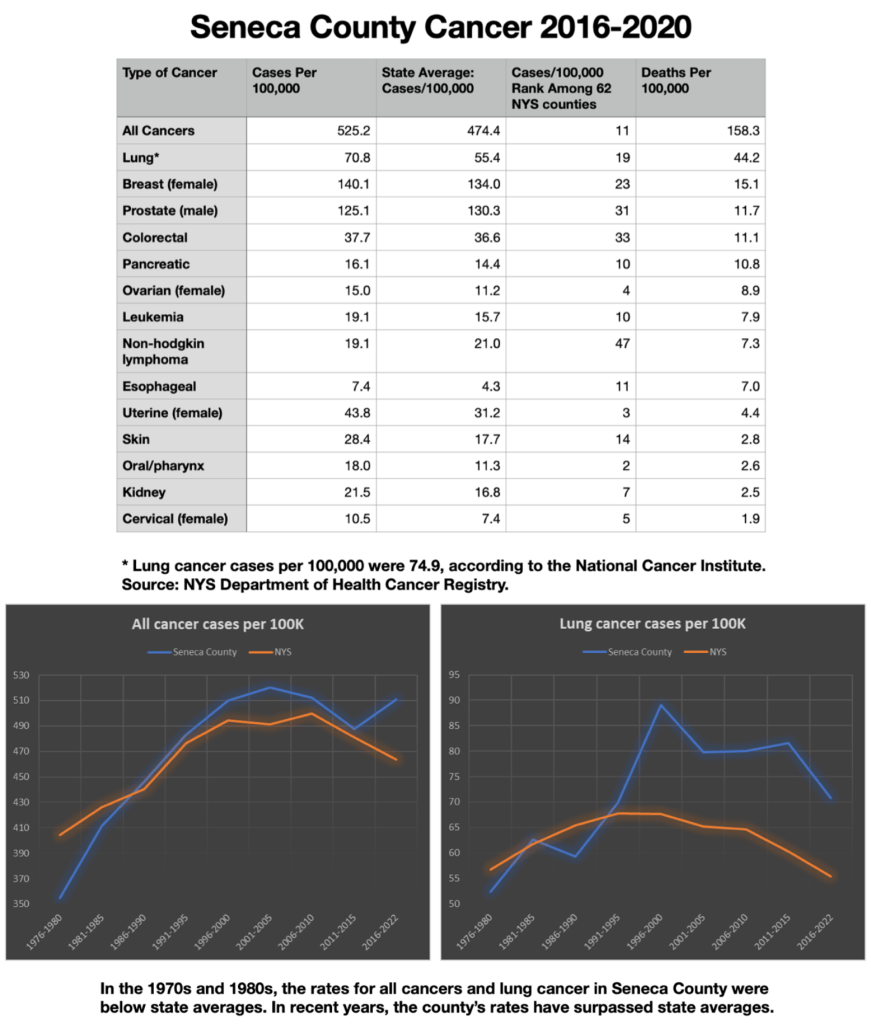
A peer review study published in 2018 found “evidence that higher ambient air pollution levels increase the risk of mouth and throat cancer.” During 2016-2020, Seneca County ranked second among the state’s 62 counties in oral/pharynx cancer, with 18 cases per 100,000 people (compared to the state average of 11.3 and the upstate average of 12.4).
Another peer reviewed study this year concluded that landfill gas was highly contaminated with the PFAS class of ‘forever chemicals.’ Exposure to PFAS has been linked to birth defects, liver and thyroid diseases and cancers.
While the presence of PFAS in landfill leachates has been well documented, the 2024 study concluded that “the amount of fluorine (as a proxy for PFAS content) leaving landfills through as emissions could be similar to, or even greater than, the amount through leachates.”
The scientific studies beg the question: What’s in the air around Seneca Meadows and Seneca Energy LFGTE, the gas-to-energy facility next door?

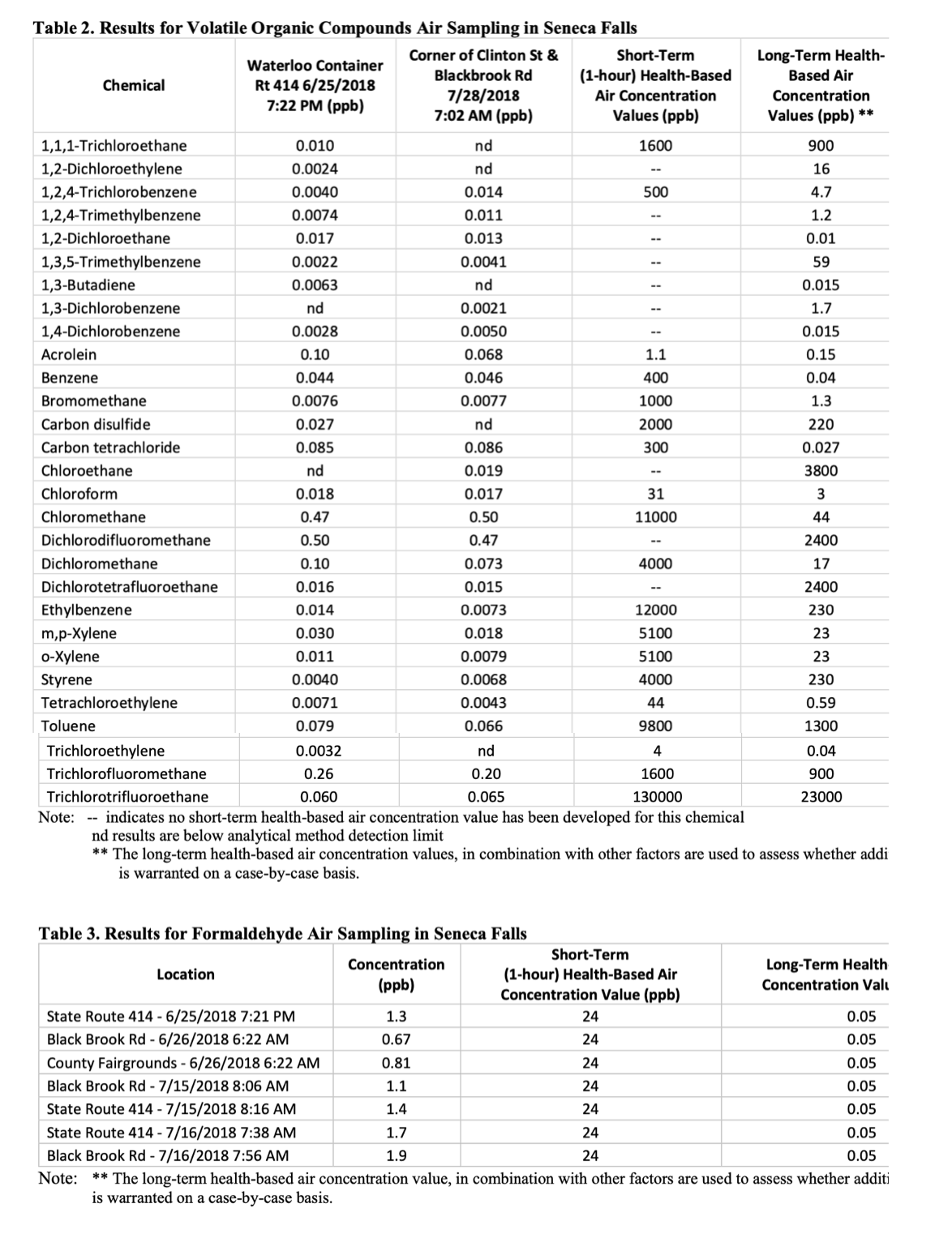
Seneca Meadows’ DEIS describes a 2019 DEC study based on air emissions data collected by local citizens and community groups. The DEC program called for measurements of 43 volatile organic compounds. Formaldehyde was added at the request of a citizen’s group because the gas-to-energy facility reportedly released 70 tons of the chemical in 2017.
The DEIS said that overall results were “below short-term and long-term health-based air concentration values.” However, the study reported that formaldehyde concentrations were significantly higher than the state’s “long-term health concentration value,” while qualifying that finding by adding that “formaldehyde concentrations are high in all areas of the state.”
Last September, Scott King, Seneca County’s Health Director, called for an updated review of air pollution around the landfill.
In a letter to the DEC’s Kimberly Merchant, King urged the agency to provide “an evaluation of the components of the odors/gas being emitted by the landfill.”
King asked that the data be promptly submitted to experts at the DOH’s Bureau of Toxic Substances Assessment so that BTSA’s conclusions could be included in the landfill’s environmental impact statement. But the BTSA is not mentioned in the DEIS.
According to the lawsuit against SMI and the DEC, which was filed in March by Seneca Lake Guardian and others, the DEC “has failed to even respond to (King), much less provided information concerning specific air contaminants present the odorous ambient air and the potential connection between these air contaminants and the cancer cluster.”
King declined to comment last week on emailed questions about his letter to the DEC and the agency’s response.
The DEC acknowledged in a statement Friday that it had agreed to extend its review of the landfill’s DEIS until Nov. 12.
WaterFront asked both the DEC and the DOH to comment on the validity of Seneca Meadows’ assertion that it has had no impact on lung cancer rates in Seneca County.
The DEC stated that the DEIS was still “under review.”
The DOH said: “Cancer data cannot indicate whether a particular environmental or other risk factor does or does not influence local incidence.”
Kyle Black, manager of the landfill, did not respond to an email seeking his comments.

 Water Front- Peter Mantius


I am not surprised that SM denies anything to do with any health issue. That is a typical response for a company seeking to continue doing business in our area. An independent party needs to complete an in-depth study as soon as possible. I am not sure that NY State will step up as they seem to support SM through their silence and lack of involvement.
LikeLike