
SENECA FALLS, Sept. 4, 2024 — The Seneca Falls Town Board voted unanimously last night to postpone until December a decision on whether to grant Seneca Meadows Inc. a local permit after several citizens complained about ‘horrendous’ landfill odors.

Previously, the board had tabled consideration of the permit in January, February, March and April in response to outcries about odors so strong they may violate the host community agreement between Seneca Falls and the landfill, which is located on its border with the town of Waterloo.
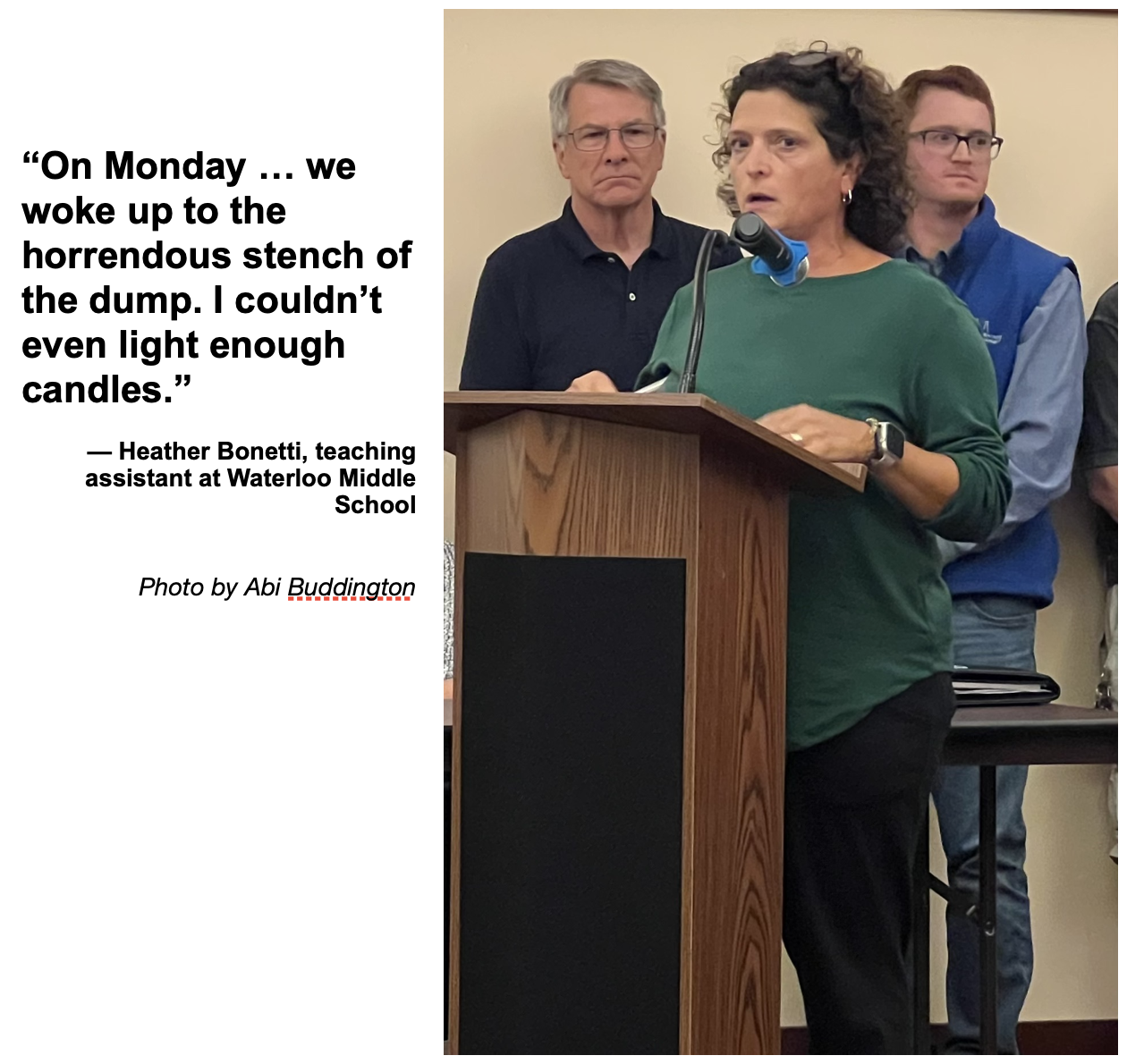
“On Monday… we woke up to the horrendous stench of the dump,” Heather Bonetti, a teaching assistant at Waterloo Middle School, told the town board Tuesday. “I couldn’t even light enough candles … Happy Labor Day, the last day of summer before I have to go back to school.”
Valerie Sandlas, a co-plaintiff with Bonetti, Seneca Lake Guardian and others in a lawsuit against Seneca Meadows, said three Waterloo schools are located within one mile of the landfill, and three Seneca Falls schools are within two miles.

“These are our neighbors’ children,” Sandlas told the board. “It’s time to protect the health and environment of Seneca County, especially the children of Seneca Falls and Waterloo.”
Because Seneca Meadows holds a state permit to operate through 2025, it has been allowed to operate for many months at a time without a local permit.
SMI has applied to renew its state solid waste management permit through 2040. The application calls for a major expansion — referred to as the valley infill project — above the inactive Tantalo hazardous waste site within the landfill. The plan calls for increasing the height of the landfill by 70 feet.
In its draft environmental impact statement (DEIS) filed with its renewal and expansion application, SMI says it will seek permits from the state Department of Environmental Conservation and the towns of Seneca Falls and Waterloo.
The DEC has stated that Seneca Meadows’ state solid waste management permit, issued under Part 360 of state environmental conservation law, does not supersede local permits. The landfill is responsible for obtaining all required permits in order to carry out activities allowed under the state permit, the DEC said in a statement to RochesterFirst.com on Sept. 4.
Last night, the Seneca Falls Town Board tabled a motion to approve SMI’s local permit without discussion after about a dozen speakers complained about landfill odors. No one spoke in favor of granting the permit.
Several claimed that landfill’s formal procedure for registering a complaint is ineffective because landfill officials routinely fail to confirm that any odor was detected. Others said landfill officials failed to show up, as requested, to check out odor reports.

Steve Churchill, a former member of the Seneca Falls town board who lives two miles east of Seneca Meadows, said the odors are especially powerful at night.
“When the windows are open, the gas not only comes into the house, it wakes you up from your sleep,” Churchill told the board. “Where I live, it’s like they release it at night … I typically don’t smell it a lot during they day. But at night I certainly do.”
Churchill said the landfill had promised in 2017 to make odor control its “top priority.” That initiative came in response to a wave of odor complaints that followed an emergency shutdown of the landfill’s gas collection system, he said.
“What have they done? Nothing,” he said. “That’s why this (local) permit certainly can’t be approved.”

Mark Pitifer, an employee at Waterloo Container, said odors inside his company’s building directly across state Route 414 from the landfill were so intense on certain days that they sickened workers.
Pitifer said his company’s owner paid more than $10,000 to obtain scientific measurements of the level of hydrogen sulfide gas — a common product of landfills — outside their building from July 24 to Aug. 25.
The results, he said, documented the validity of the company’s long-standing complaints about a rotten egg smell that often causes headaches.
Pitifer cited the World Health Organization’s recommendation that hydrogen sulfide (H2S) concentrations not exceed 5 parts per billion to avoid “substantial” odor complaints.

Dozens of readings outside Waterloo Container showed H2S concentrations ranging up to 10 parts per billion, he said. None were less than 4 ppb. Of 16 readings taken between Aug. 20 and Aug. 25, nine were higher than the WHO threshold of 5 ppb.
Bonetti, a Seneca Falls resident, urged the town board to deny SMI’s bid for a local permit. “I am begging each of you, I demand each of you to vote no. Enough is enough,” she said. “It is our constitutional right. New York State has the Green Amendment … that entitles us to clean air, clean water and a healthful environment.”
Sandlas not only urged the board to deny the local permit, but also to follow up by explaining their stance to state officials.
“Please deny the permit and please tell Albany and the DEC and the governor and the state Health Department that we do not support the expansion of Seneca Meadows.”
Kyle Black, manager of Seneca Meadows, did not respond to an email from WaterFront requesting comment on the town board’s decision to postpone action on a local permit.

 Water Front- Peter Mantius