

DRESDEN, Aug. 29, 2024 — The judge presiding over a Greenidge Generation LLC lawsuit against the state Department of Environmental Conservation abruptly recused himself last week — one day after he temporarily blocked a DEC order to shut down the company’s power plant by Sept. 9.

An attorney for the agency challenged the legality of the ruling by Judge Jason L. Cook, but he said the DEC would agree to postpone enforcement of its order to cease operations at the plant until Nov. 1.
Under an agreement between attorneys for the DEC and Greenidge, the Dresden plant, which powers a Bitcoin mining facility, would get a seven-week reprieve.
On Aug. 20, Judge Cook issued an order that said the DEC was “enjoined and restrained” from taking any steps to require Greenidge to cease plant operations pending his ruling on a requested preliminary injunction.
Nicholas C. Buttino, an assistant state attorney general representing DEC, said Cook had effectively granted a temporary restraining order (TRO) on the same day Greenidge requested it “without giving (DEC) an opportunity to be heard, as required by established law.”

Cook’s TRO “was void on its face because the issuing court was without authority to grant it … and therefore need not have been obeyed by (DEC),” Buttino wrote to Carol. B. Wilson, the Clerk of Yates County Supreme Court, on Aug. 23.
Buttino told Wilson that four environmental groups who had petitioned Cook to intervene in the case also “do not consent” to the extension of the TRO until they are heard on the matter.
Buttino said Cook recused himself Aug. 21, before ruling on whether to allow the groups — Seneca Lake Guardian, the Sierra Club, the Committee to Preserve the Finger Lakes and Fossil Free Tompkins — to participate in the case.
Cook had scheduled a Sept. 3 hearing on Greenidge’s request for an injunction, but that has been canceled, a court clerk said Wednesday.
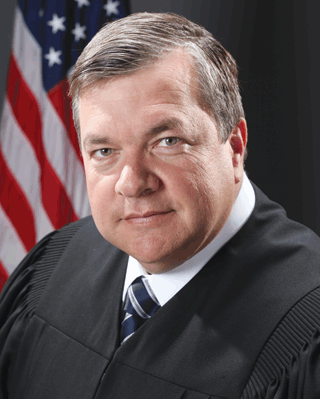
Greenidge’s lawsuit has been reassigned to Monroe County Supreme Court Judge Vincent M. Dinolfo. (After this article was first posted, Judge Dinolfo set a schedule for brief filings and a hearing on Oct. 29.)
Late Wednesday, attorneys for the four environmental groups filed a 22-page memorandum of law opposing Greenidge’s bid for a TRO or a preliminary injunction. It was addressed to Judge Dinolfo, who will also review the plan to grant the plant a reprieve.
That deal is spelled out in an Aug. 23 filing signed by Buttino and Yvonne Hennessey, an attorney for Greenidge. In it, they stipulate that “Greenidge need not cease operations of any air contamination sources located at the (Dresden power plant), render such air contamination sources inoperable, or relinquish the Title V air permit until Nov. 1, 2024.”
Greenidge’s Title V air emissions permit expired in September 2021, but it remained in effect because the company filed an application to renew it.

In June 2022, the DEC denied the renewal application on the grounds that the plant had significantly boosted its power generation and emissions to serve the Bitcoin operation beginning in 2020.

The agency concluded that plant’s emissions levels conflicted with the goals of state’s 2019 climate law, which requires the state to cut greenhouse gas emissions by 40 percent from 1990 levels by 2030 and 85 percent by 2050.
After the DEC denied the permit in 2022, Greenidge appealed the decision within the agency. The DEC terminated that appeal on May 8, and Greenidge filed an Article 78 lawsuit Aug. 15.
Greenidge President Dale Irwin called the agency’s decision to end the appeal “absurd … arbitrary, capricious and utterly preposterous.”
In a statement, Irwin said: ”DEC’s political bias in this matter has been clear for years…”
But several times in recent years attorneys for the DEC and Greenidge have sat at the same counsel’s table to argue against challenges to agency permitting decisions.
In fact, Hennessey and Buttino shared a victory over the Sierra Club, Seneca Lake Guardian and others who had brought a 2017 lawsuit that targeted Greenidge’s water permit.
Hennessey is an attorney with Barclay Damon, a regional law firm with nearly 300 attorneys. Over the past decade, at least half a dozen Barclay Damon attorneys have worked on Greenidge regulatory matters and court cases.

Judge Cook, who has not publicly explained the reason for his recusal, has an indirect connection to Barclay Damon.
Cook began his legal career as an attorney with Davidson & O’Mara, a seven-member Elmira firm that Barclay Damon acquired in January 2014. The firm’s founder, John O’Mara, had been a highly influential ally of Gov. George Pataki. His son, state Sen. Tom O’Mara (R-Big Flats), was also a partner.
Cook left the Elmira firm several years before the merger with Barclay Damon, and he became an assistant district attorney in Yates County from 2010 to 2013. He later worked as an assistant district attorney in Chemung, Steuben and Schuyler counties. Cook began serving as a Yates County Judge in 2017, and he won his Supreme Court post in 2022.
Barclay Damon acquired Davidson & O’Mara as it was beginning a longstanding relationship with Greenidge and Atlas Holdings, the Connecticut private equity group that acquired it in February 2014.

The year before Atlas bought the long shuttered coal-burning plant, it had hired Frank Bifera, a Barclay Damon lawyer who had been the DEC’s general counsel, to justify favorable terms for the plant’s state air permit.
When it acquired Davidson & O’Mara, the firm added a politically influential partner: Senator O’Mara. The Greenidge power plant lies within his Senate district.
One year later, in January 2015, O’Mara was appointed chair of the Senate Committee on Environmental Conservation.
Two months after that, O’Mara and Bifera joined an Atlas co-founder in a meeting in then-Gov. Andrew Cuomo’s executive offices with the commissioner and general counsel of the DEC to discuss Greenidge permitting issues. (O’Mara later told WaterFront that he wasn’t aware when he entered the meeting that Barclay Damon represented Greenidge.)

Over the next year the DEC issued a series of company-friendly regulatory rulings that cleared the way for the plant to convert to natural gas fuel and reopen.
For example, the agency allowed the plant to restart in 2017 without preparing an environmental impact statement and without up-to-date water withdrawal and discharge permits. And the plant was granted a five-year grace period to operate without fish screens on its water intake pipe in Seneca Lake, despite a requirement under the federal Clean Water Act.
Before Cook recused, members of the environmental groups seeking to intervene in the Greenidge case were aware of the judge’s early career ties to O’Mara. But they did not conclude that the connection was direct or current enough request his recusal from the case and declined to discuss the matter.

 Water Front- Peter Mantius
