

(Updated with Schuyler County Legislature vote).
WATKINS GLEN, Feb. 12, 2024 — On the eve of two state-sponsored public hearings on a plan to quintuple the size of the Padua Ridge sand and gravel mine, the Schuyler County Legislature today passed a resolution opposing any quick approval of the project.

Elected officials in Watkins Glen and Schuyler County had long assumed that efforts to expand the mine had died in 2008 in the wake of intense local opposition. They had no idea the state Department of Environmental Conservation was quietly considering various new versions of the expansion plan for well over a decade without ever notifying them.
The DEC shocked them when it disclosed in early January that it was preparing to issue a state permit for the latest plan to quintuple the mine’s acreage, as described in a newly released 784-page draft environmental impact statement (DEIS). Most local officials learned about the plan from a WaterFront blog post on Jan. 11.
The agency held a virtual public hearing today from 6-8 pm and plans a second in-person hearing tomorrow from 2-7:30 pm at the Watkins Glen Community Center. It said it would receive written comments through Feb. 28.
The county Legislature’s resolution, which passed by a 5-0 vote, states:
“Whereas the Schuyler County Legislature objects to DEC activating an application dormant for 16 years without requiring a new initial review … (and) objects to DEC’s failure to notify our county of the proposed action … (and) the proposed time period is insufficient to review the 784 pages of documents that are on file with the DEC, and to hire required experts to review the record…”
Meanwhile, opponents of the initial bid to expand the mine in 2007-2008 have appealed to the DEC to extend the comment period for the latest plan by 60 or 90 days.
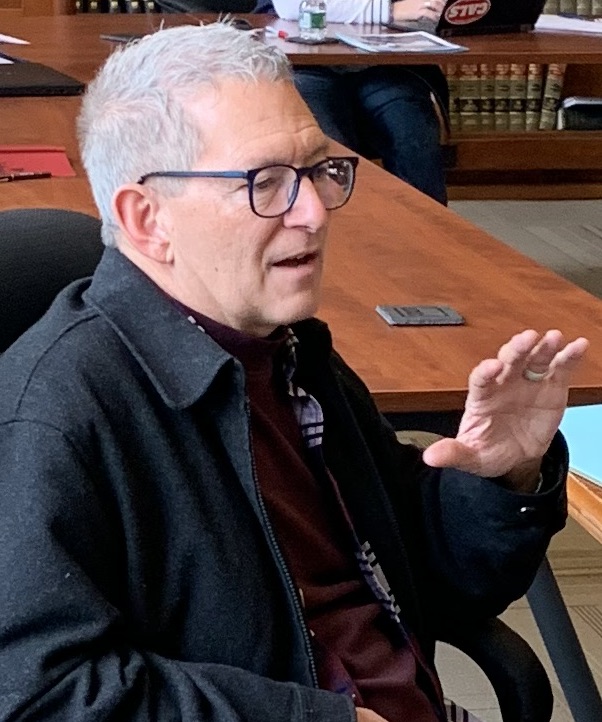
“The (proposed) mine permit puts in immediate peril the Watkins Glen State Park and the tourism it generates,” Mark Stephany wrote to the DEC’s Frances Knickmeyer at the agency’s Region 8 office in Avon.
“To the DEC Avon office, the sand and gravel is a mere resource,” Stephany added. “To (the mine owner, IGN), it is a source of revenue. However, to us it is our State Park. It is the land where we bury our dead. It is our hillside, our home where we raised our children. It is our history and our economy.”
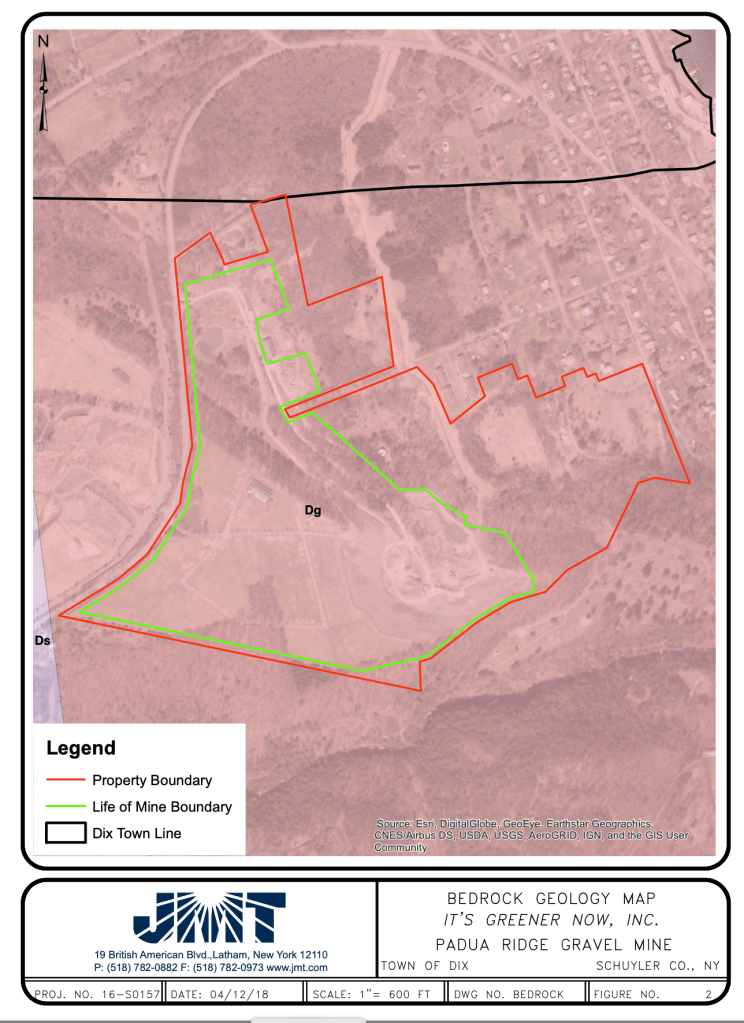
The Padua Ridge gravel pit is currently permitted to operate on 14.33 acres adjacent to the Watkins Glen State Park and the St. Mary’s Cemetery. The owner, It’s Greener Now Inc. (IGN), proposes to expand it by 60.95 acres.

According to the DEC’s Environmental Notice Bulletin, the permit would allow IGN to extract 3.5 million cubic yards of sand and gravel over 20 years without adding any truck traffic.
Kate Bartholomew, chair of the Schuyler County Environmental Management Council, noted that while the “letter of the law” did not require DEC to notify local officials that the defeated 2008 plan was being actively revised, “basic decency should have warranted a heads up” to her and other local officials.
In fact, DEC officials remained tight-lipped about their consideration of another plan in 2019 and a third one in 2022.

“Technically, DEC didn’t have to publish notification until it deemed the DEIS complete,” Bartholomew said. When the agency did so last month, it was legally obligated to finally release the 784-page document.
That DEIS was based on a 2008 final scoping outline that excluded consideration of “dust, vibration and truck traffic,” according to a Sept. 1, 2021 letter written by an IGN consultant to the New York State Historic Preservation Office (NYSHPO).
While local officials in Watkins Glen were oblivious to even the existence of the 2019 mine expansion plan, the New York State Office of Parks, Recreation and Historic Preservation (NYSOPRHP) expressed deep skepticism about it.
“Our office is particularly concerned with … the specific impacts to the (Watkins Glen State Park) that might arise from the mine expansion,” NYSOPRHP stated. “We found no assessment of anticipated increases in noise, dust, vibration, truck traffic or other direct and indirect impacts that the expansion of this extractive industrial (cq) would have on the historic park.”

The state recently announced that the Watkins Glen State Park drew a record 1.2 million visitors in 2023, up from about one million in 2021 and 2022.
In December 2021, four months after Kathy Hochul was sworn in as governor, NYSOPRHP declared that all its concerns about threats to the park had been resolved.
In addition to potential threats to the park, Village of Watkins Glen Mayor Laurie DeNardo said she was worried about truck traffic from the mine.
“Think about the traffic going up and down the hill through the village if they are allowed to expand,” DeNardo said in a January interview with WaterFront. “There’s no way to go around. They have to go down (Route) 409.”
The 784-page DEIS for the plan to quintuple the size of the mine includes a two-paragraph section labeled “traffic,” which states: “Truck traffic to and from the site will not be increased by the proposed expansion, as the increase in affected area is a continuation of existing mine operations.”
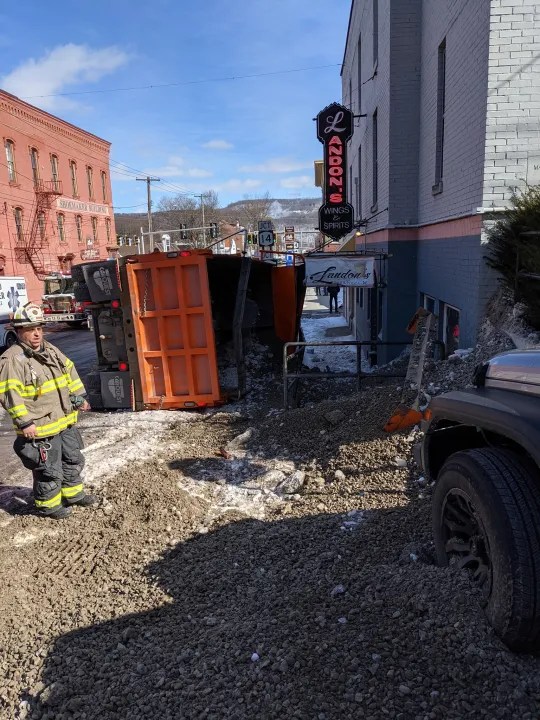
The DEIS does not mention the rollover crash of a gravel truck on Route 409 in February 2021. The truck flipped at the bottom of a long hill where Route 409 bends sharply, spraying gravel across a wide area 60 meters from Watkins Glen’s busiest intersection.
Because the mine is located on a steep hill above a residential neighborhood and the village, several local residents expressed concern about stormwater runoff during increasingly common heavy rains.
Wayne Weber, a former village trustee who lives on the hill below the mine, said: “Everyone who lives on the side hill knows how delicate the storm water situation is now. With that (proposed) expansion … there are chances of catastrophic type damages.”
Michelle Hyde, a former manager of Clute Park in Watkins Glen, said storm runoff threatens not only the hillside neighborhood, but also the village itself due to water rushing from the park’s gorge down the village canal.
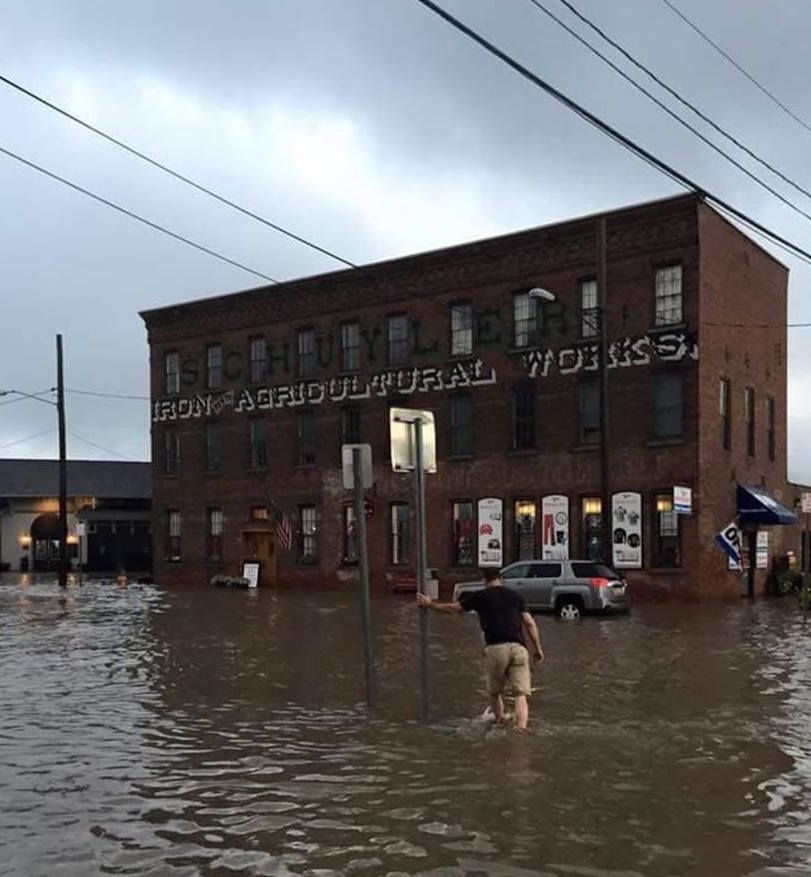
“The gorge in 2021 was closed twice just for a day each time because it was flooded,” Hyde said. “Last year they almost closed it. The (heavy rain) events are getting closer and closer together.”
Weber and Hyde made their comments during a gathering of concerned citizens at the village offices Sunday afternoon in advance of the DEC hearings and tonight’s meeting of the Schuyler County Legislature.
The county Legislature’s resolution passed by a 5-0 vote. Two legislators, David Reed and Gary Gray, were absent. Phil Barnes, who lives on the hill below the mine, abstained.
The resolution notes that the DEC never notified local officials when it received applications in 2019 and 2022 to expand the mine. It said the latest plan “appears to impact noise, traffic and hydrological characteristics of the (mine) site,” and that the DEC is allowing insufficient time to analyze those and other issues.
The resolution called on the DEC to “conduct a full, fair and exhaustive environmental review of the project.”
IGN is owned by Martin Wojcik, who first sought to expand the mine in 2007.

Initially, the DEC issued a “negative declaration” on that proposal, ruling that it would have no significant environmental impact. That decision meant that Wojcik didn’t need to prepare an environmental impact statement (EIS).
But after Stephany led a group of hillside residents in months of protest, the DEC reversed its position and required an EIS.
Sixteen years later DEC announced that it had finally accepted a draft EIS from Wojcik.
One earlier version — never shown to local officials and never approved by DEC — had sought to expand the 14.33-acre mine to 94.63 acres, compared to the 75.28 acres now under consideration.
At that time, Wojcik was also seeking state permission to dig a tunnel under Route 409, to construct a rail siding and to mine below the seasonal groundwater table. Those aspects of the plan were dropped “to further mitigate or eliminate potential environmental impacts,” the DEIS says.
Documents dealing with negotiations over details of those rejected earlier plans show that courtesy copies were sent to various state officials, Wojcik and “K. Roe, Barclay Damon.”

Kevin Roe is a partner at the law firm of Barclay Damon.

State Sen. Tom O’Mara (R-Big Flats), whose district includes Watkins Glen, is also a compensated partner at the same firm, Barclay Damon.
An in-person hearing is set for 2 p.m. Feb. 13 at the Watkins Glen Community Center. (It was initially scheduled to be held at the Seneca Lake Events Center at Clute Park).
After DeNardo and others asked the DEC to move the hearing to a time that would be more convenient for town residents, the agency agreed to extend the hearing through 7:30 p.m.
It will be conducted by Molly McBride, an administrative law judge at DEC.

 Water Front- Peter Mantius
so many thanks, Peter, for keeping us in the loop.
LikeLike
Thankfully, Mantius does it again! This is the kind of reporting that is do badly needed. Without this, it seems the DEC would have steam-rolled along with little or no local involvement.
As with Greenidge in Dresden, the sewage sludge dumping on Bath farm fields, the expanded landfill in Seneca Falls, and potentially the “forever chemical” PFAS contamination in Seneca Lake, Peter Mantius has shown there’s a lack of transparency within the NYS DEC.
LikeLike
Great investigative reporting Pete! Your dedication to environmental issues in the region is incredible. Keep DEC’s ” toes to the fire”.
In the 1990’s I had to deal with a gravel pit 150 feet from my front door in Horseheads. Ten years of dust, noise and a drainage problem( which continues to this day). Literally dozens of calls to DEC to make the operator follow state laws were a waste of time. DEC acted more like a partner with the pit operator than an overseer/regulator of the gravel pit.
There was never any amelioration of the pit after it completed its operation. If you look at the gravel pits in the area, there is rarely any tree plantings or seeding after the operations permit expires. The photos in your article show several new reservoirs which could present a problem in the future if the area is subject to a week of rain. Another issue is the insurance/bonds which DEC requires. The amount is a pittance compared to the cost if there is a major problem.
Hopefully, the public sentiment will have positive results.
LikeLike