
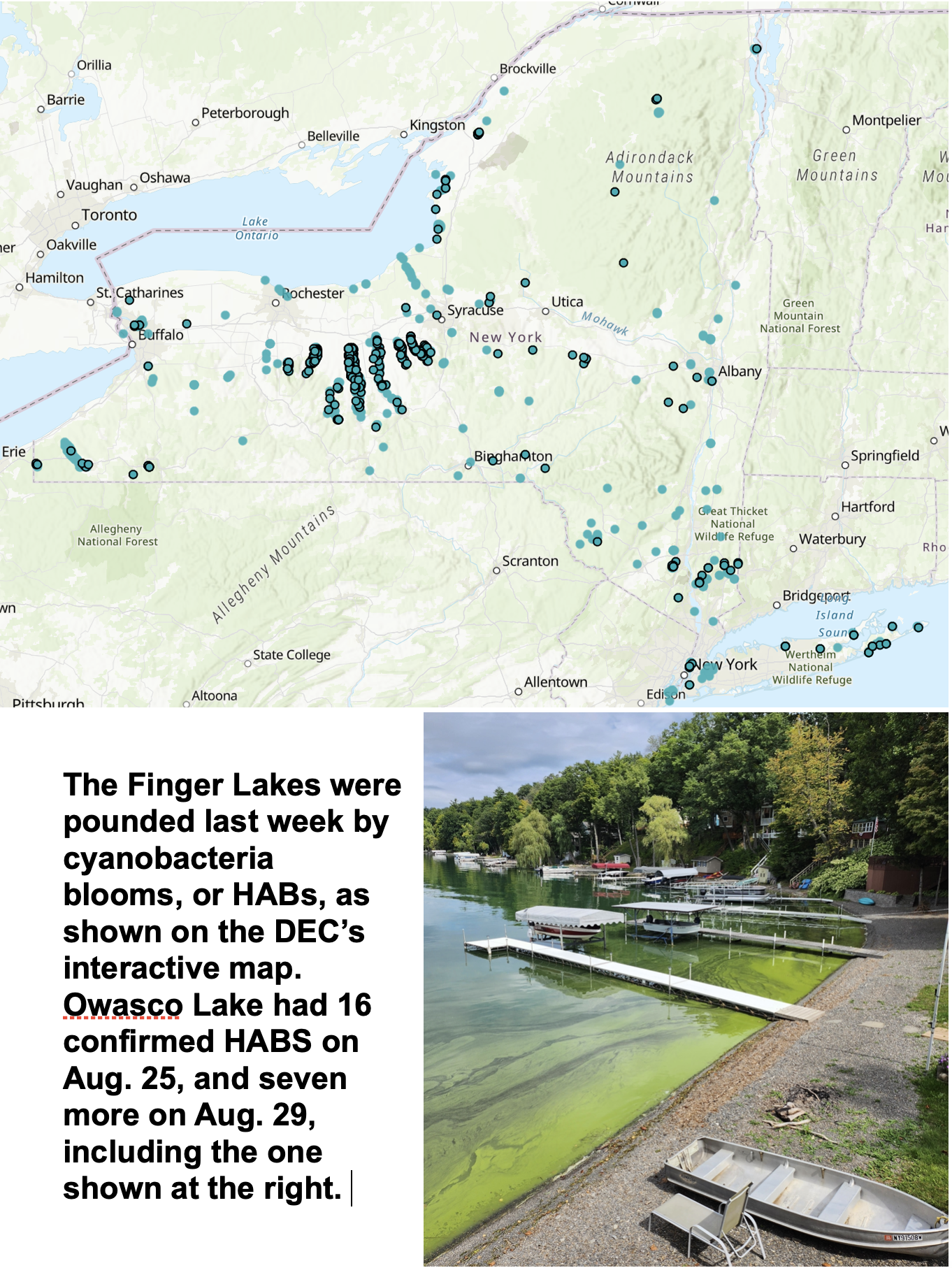
SKANEATELES, Sept. 2, 2024 — More than 200 confirmed blooms of cyanobacteria hit the Finger Lakes during the final week of August in one of the most widespread outbreaks on record.
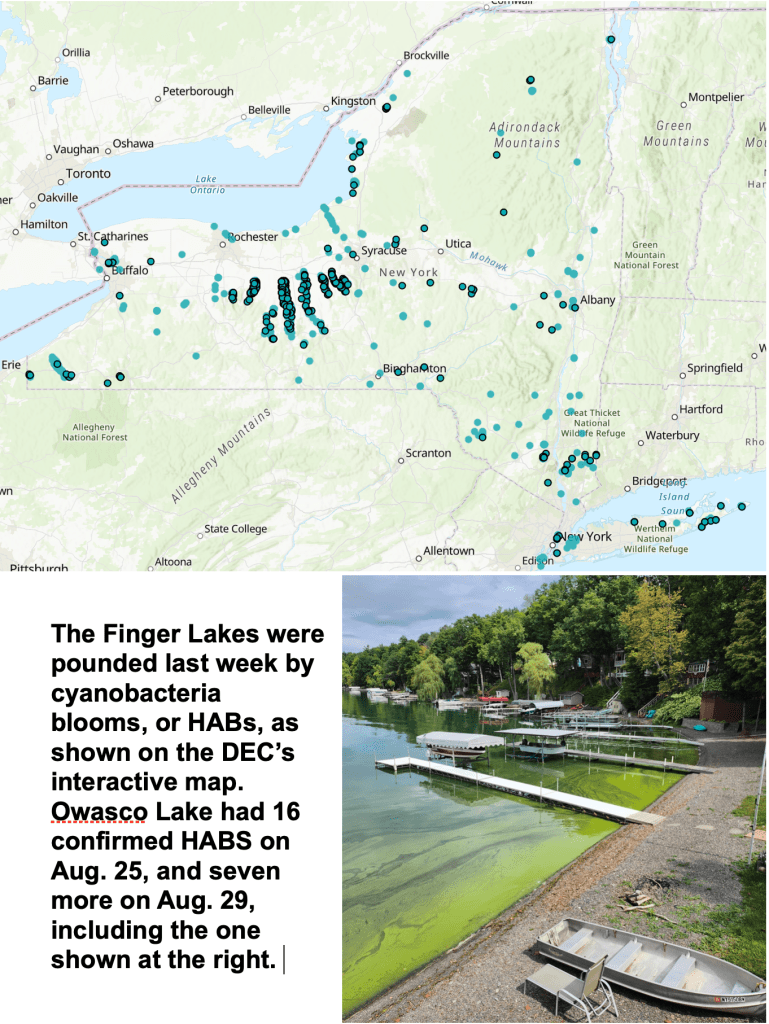
The state’s interactive map of so-called harmful algal blooms (HABs) shows that the Finger Lakes suffered far more than any other region in the state.
The six largest Finger Lakes all had days with at least half a dozen confirmed blooms — even Skaneateles Lake, which is known for its water purity. Skaneateles, which provides unfiltered drinking water to Syracuse, logged 13 confirmed blooms on both Aug. 26 and Aug. 29.
Seneca Lake had one of its worst weeks ever, with more than 50 confirmed blooms between Aug. 24 and 29, according to the state Department of Environmental Conservation.
“Although some of the increase in reported sightings can be attributed to better monitoring programs by the (DEC), lake associations, and citizen scientists, the overall trend in the Finger Lakes and across the state suggests (cyanobacteria blooms) are increasing in range, frequency and intensity,” scientists Richard W. Smith and Stella C. Woodard wrote in a recent column in the Finger Lakes Times.
“After days of sunshine, warm temps — and lots of HABS — things have slowed down.” Seneca Lake Pure Waters Association reported on its Facebook page Aug. 28. “But despite the cloudy skies and cooler temps this morning we have had HAB reports come in still.”
In fact, Seneca had seven more confirmed blooms that day and 20 more on Aug. 29, according to the DEC’s interactive map.
Cyanobacteria thrives in warm, calm conditions. The toxins they often produce can cause skin rashes, eye irritation and serious liver damage. They have been know to kill pets, livestock and wildlife.

Dangerous blooms can appear as green streaks in the water or look like spilled paint or pea soup. They can linger or vanish quickly, depending on wind and wave action. They tend to increase toward the end of summer and into early fall before subsiding in mid-October.
The DEC accepts reports of blooms from volunteers and rules them confirmed based on pictures supplied as visual evidence. Almost all confirmed blooms noted on the DEC’s interactive map have links to pictures.
The state Department of Health closes state-run beaches based on visual evidence of a bloom. Beaches run by counties or private entities have less specific rules, and bathers don’t necessarily obey them or posted signs.
For example, the Deep Run Beach, an Ontario County facility located in Gorham on the east side of Canandaigua Lake, had several apparent blooms last month. One picture provided by the Canandaigua Lake Watershed Association showed swimmers ignoring empty life guard stands and an obvious bloom.
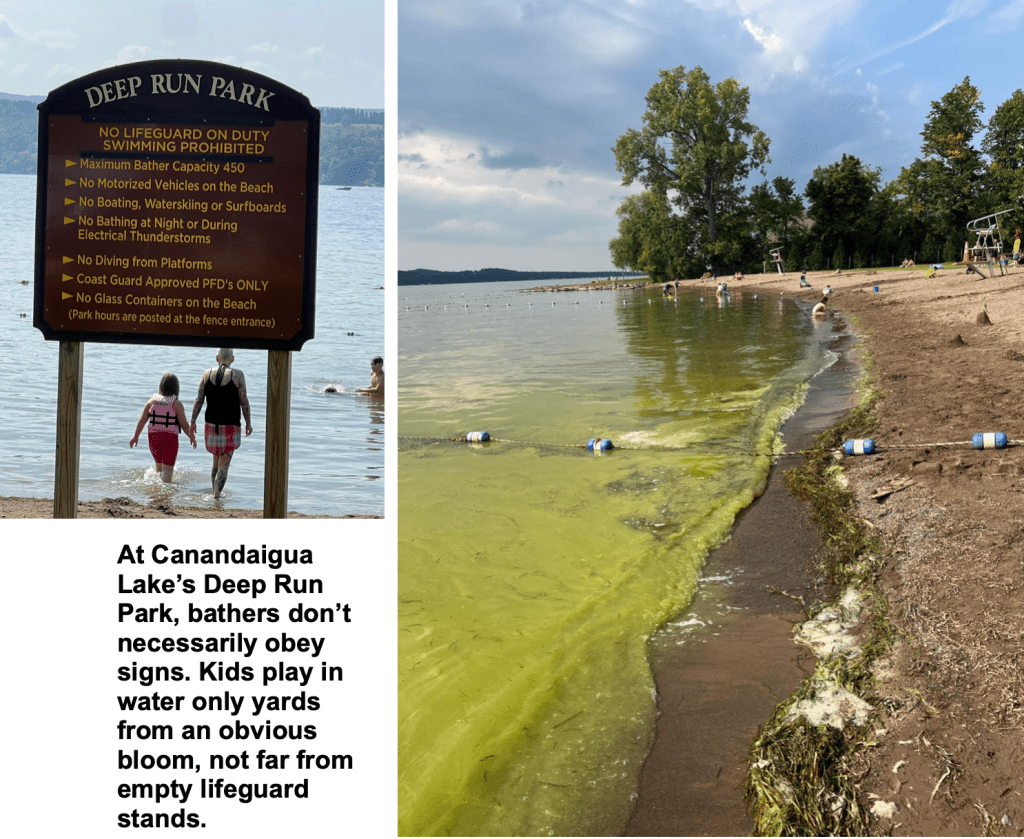
The DEC reported 13 cyanobacteria blooms on Canandaigua on both Aug. 24 and Aug. 26.
Generally, cyanobacteria thrives in water with high levels of nutrients like phosphorous and nitrogen.
But scientists still aren’t able to reliably predict when a bloom will occur, and cyanobacteria doesn’t necessarily require high levels of nutrients to thrive.
For example, Skaneateles is a relatively low-nutrient lake. That did not protect it from the latest wave of blooms that are likely to raise fresh questions about how Syracuse will protect its public tap water drawn from the lake.
The Finger Lakes supply several hundred thousand people with drinking water.

Several water systems in the region have reported cyanotoxins in the raw water they draw from one of the Finger Lakes. The toxins have even reached the finished drinking water in Gorham, Auburn and the Town of Owasco, and they have spent millions of dollars upgrading their filtration systems.
The steady increase in confirmed HABs over the past several years has spurred residents and officials around Owasco Lake to develop proposed enforceable rules to minimize the phosphorous and nitrogen runoff from farms in their watershed.
But the DOH recently informed them that their proposed rules were not necessary. That has triggered a pending lawsuit against the DOH and the state Department of Agriculture and Markets.
Meanwhile, the Hochul Administration has touted a $42 million HABs-prevention program that funds efforts by farmers to reduce nutrient runoff from their fields.
“New York continues to use every tool available as we build on local conservation efforts and assist our farmers and communities to improve resiliency, prevent pollution that can contribute to harmful algal blooms, and take great strides to achieving our climate goals,” Gov. Kathy Hochul said in a press release Aug. 23.

 Water Front- Peter Mantius