
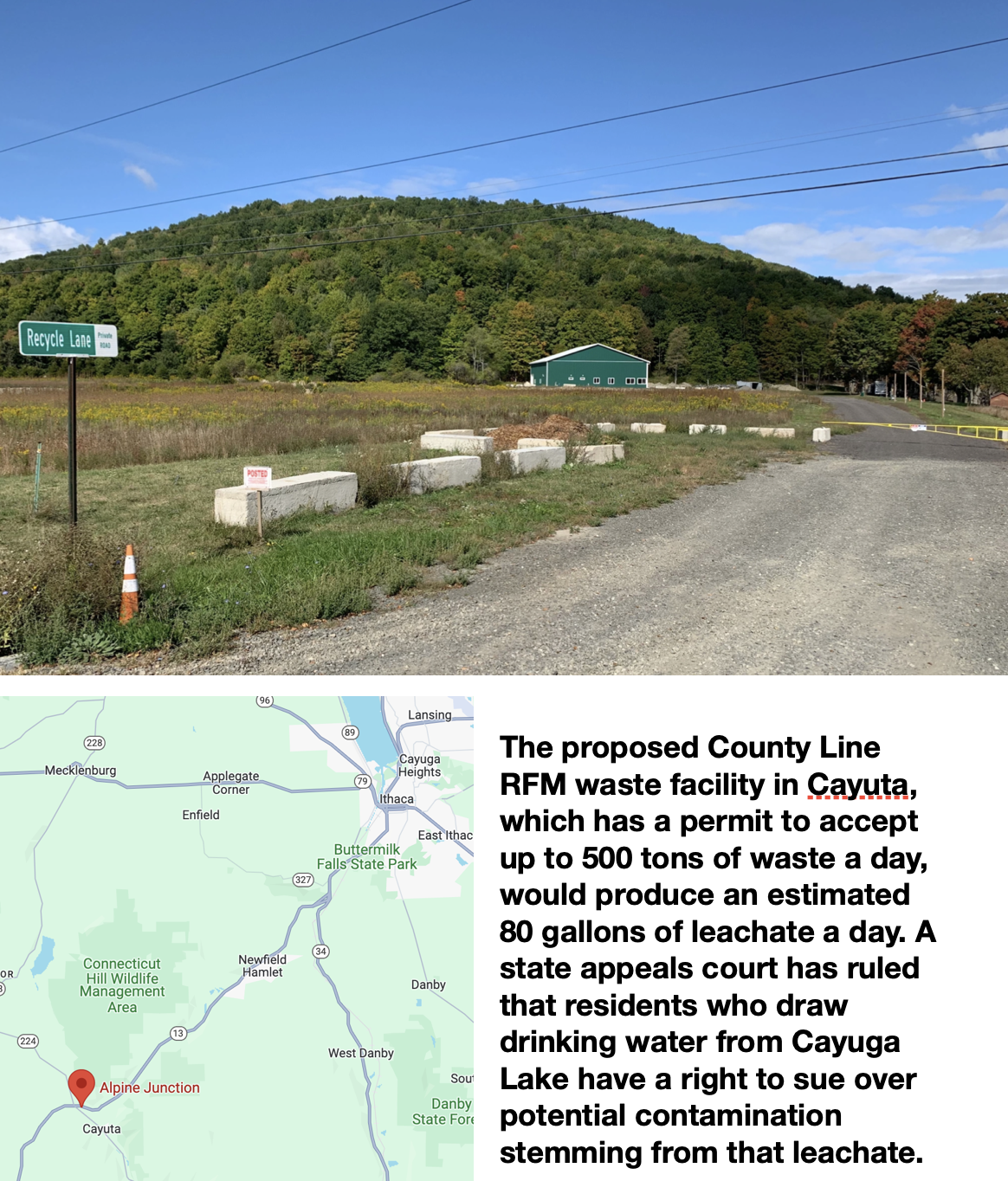
CAYUTA, July 20, 2024 — A state appeals court in Albany has revived a lawsuit alleging that waste from a proposed recycling center in Schuyler County would contaminate drinking water drawn from Cayuga Lake.

Residents who rely on potentially tainted water from the lake have standing to sue under the ruling issued Thursday by five judges of the Third Department of the New York Supreme Court’s Appellate Division.
“The (appellate) court recognized that people who could be harmed by pollution should get their day in court,” said Hillary Aidan, an Earthjustice attorney who represents the nonprofit environmental group Seneca Lake Guardian (SLG).
The decision has implications for the state’s largest landfills and others who ship leachate laced with PFAS ‘forever chemicals’ to water treatment plants that discharge effluent into lakes and streams, some of which are sources of public drinking water.
Most water treatment plants that receive landfill leachate aren’t equipped to remove PFAS, a class a man-made chemicals that persist in the environment and have been linked to adverse effects on human urinary, immune, reproductive and nervous systems, as well as cancer and low birth weight.
The appellate ruling overturns the Supreme Court of Tompkins County’s 2023 dismissal of a suit filed by SLG against County Line MRF LLC and the state Department of Environmental Conservation, which granted it a permit to operate.

The facility is located on a 7.49-acre site near Alpine Junction in Cayuta, about 16 miles southwest of Ithaca. The permit obtained by owner Robert Mente allows County Line to accept up to 500 tons of municipal waste per day.
The suit, filed in 2022, claimed the recycling center planned to send the leachate it produces to the Ithaca Area Wastewater Treatment Facility, which discharges into Cayuga Lake without first removing the PFAS chemicals.
Three SLG members obtain their drinking water from the lake, where they also enjoy swimming, kayaking and fishing. One of those members, Mitchell Lavine, draws water from a beach well several feet from Cayuga’s shoreline.
In dismissing the suit last year, the Tompkins court noted that County Line would produce about 80 gallons of leachate per day. It ruled that such “modest discharges” — and the distance the SLG members live from the treatment facility — made it “apparent” that the alleged harms were “speculative.”
The appellate judges disagreed.
“In their motions to dismiss,” the appeals court wrote, “neither County Line nor DEC provided evidence rebutting petitioner’s allegations that the leachate would contain PFAS; that pursuant to County Line’s permit application, the leachate would be transferred to and processed by the Ithaca treatment facility; that the Ithaca treatment facility could not completely filter out PFAS; that the treated leachate containing PFAS would ultimately get disposed of by being dumped into Cayuga Lake; or that the individual member’s reliance on beach wells for drinking water would expose him to PFAS in a manner that is different than the public at large.”
Similar issues may apply to the manner in which the state’s largest landfills dispose of their own PFAS-contaminated leachate.
TestAmerica data from 2018 shows that leachate from several of major landfills was contaminated with PFOA and PFOS, two common PFAS compounds, at thousands of parts per trillion. The federal limit for each substance in public drinking water is 4 ppt.
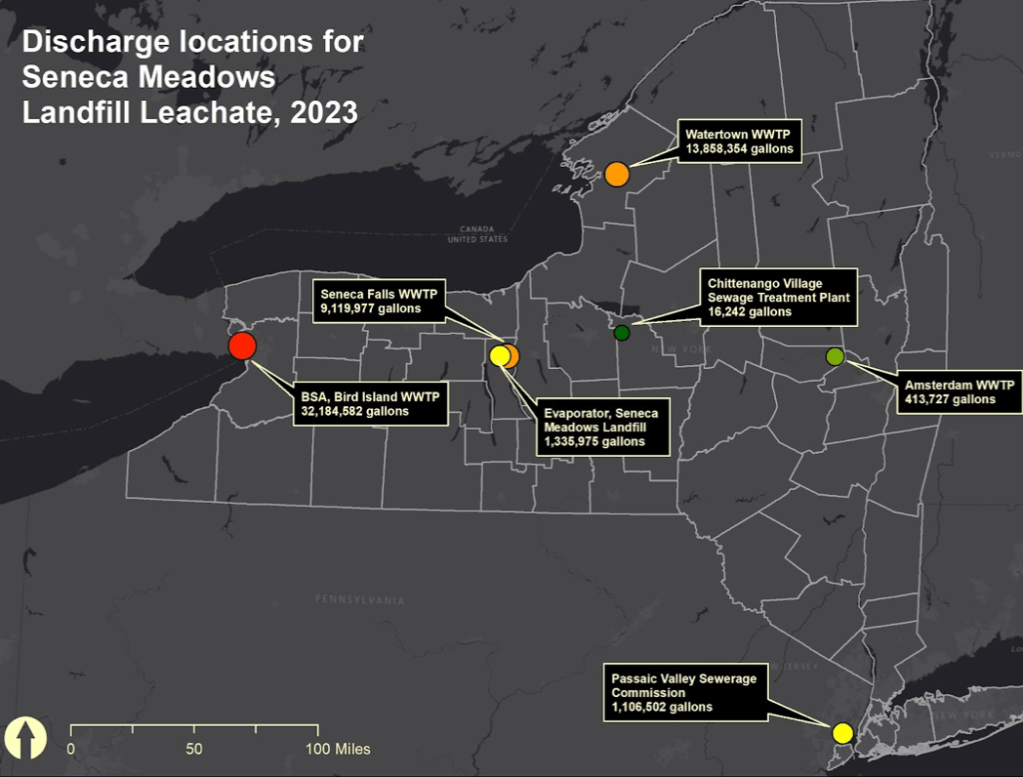
Seneca Meadows Inc., the state’s largest landfill in Seneca Falls, produces up to 200,000 gallons of leachate a day (2,500 times County Line’s leachate volume) and has shipped much of it to water treatment facilities in Buffalo, Watertown, Chittenango and Steuben County.
“We are closely watching the state’s decision on Seneca Meadows’ request to expand the landfill and hope that the Department of Environmental Conservation will take a careful look at the impacts of the landfill’s PFAS-laden leachate on multiple communities,” said SLG co-founder Yvonne Taylor.
DEC regulations require an applicant for a permit for a waste processing facility to show how it will legally dispose of its waste.

SLG had urged the DEC to reject County Line’s permit application because it had failed to identify a facility that was authorized to accept its contaminated leachate. After the agency issued County Line a permit, SLG sued.
In its appeal of the Tompkins County court’s dismissal, SLG argued that the court had been legally obligated to “accept the facts as alleged as true and draw inferences in Seneca Lake Guardian’s favor.” Instead, it incorrectly held that SLG lacked standing to sue because it had failed to “establish” its allegations.
The environmental group further argued that the dismissal order “runs afoul of fundamental procedural principles as well as the Court of Appeals’ instruction that standing rules ‘should not be heavy-handed.’”
The appeals court found those arguments persuasive.
While the ruling supported SLG’s standing to bring suit, it did not endorse all of the group’s allegations.
“To the extent that we have not addressed petitioner’s remaining contentions, they have been reviewed and lack merit,” the court said.
The lawsuit has been returned to Tompkins County Supreme Court.

 Water Front- Peter Mantius